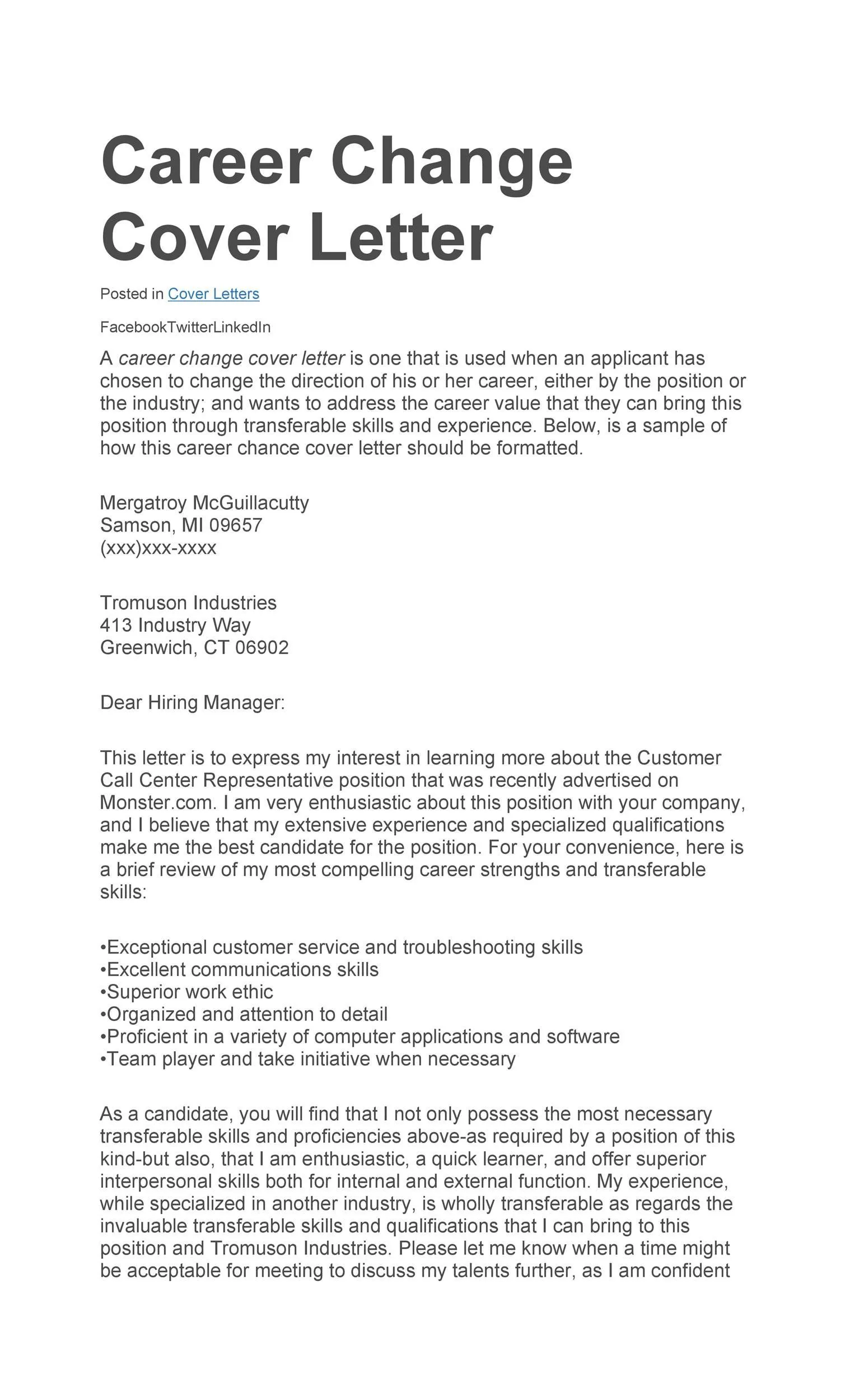
Understanding the Importance of a Career Change Cover Letter
Embarking on a career change can be an exciting yet daunting prospect. While your resume provides a factual account of your work history, a cover letter serves as your personalized introduction, allowing you to articulate your motivations, highlight relevant skills, and demonstrate why you’re a strong candidate for a new role. In the context of a career change, a cover letter is even more crucial because it helps you bridge the gap between your past experience and your desired future. It provides context and allows you to explain why you are making the switch and how your skills are transferrable.
Why a Cover Letter is Crucial for Career Changers
A well-crafted cover letter addresses the elephant in the room – the career change itself. It provides an opportunity to explain your rationale for the shift. This is where you can demonstrate your understanding of the new field, your commitment to the transition, and your enthusiasm for the opportunity. A cover letter can effectively address the employer’s potential concerns about your lack of direct experience in the new field. By focusing on the transferable skills, relevant experiences, and your passion, you can assuage these concerns and make a compelling case for your candidacy. A strong cover letter, therefore, is not just a formality, but a strategic tool for career changers.
Highlighting Transferable Skills

One of the most effective strategies for career changers is to emphasize their transferable skills. These are the skills and abilities you’ve developed in previous roles that are applicable in your new field. Common transferable skills include communication, problem-solving, leadership, teamwork, and project management. In your cover letter, identify the skills that are most relevant to the job description and provide specific examples of how you’ve demonstrated these skills in the past. This demonstrates to the potential employer how you can bring value to the team.
Structuring Your Career Change Cover Letter
A well-structured cover letter is easy to read and conveys your message clearly. Organize your letter logically, with each section serving a specific purpose. A clear structure allows the reader to quickly understand your background, the reasons for your career change, and how your skills align with the new role. Make sure your letter is easy to read, scannable, and demonstrates your professionalism.
Header and Contact Information
Start with your contact information at the top of the letter, including your name, address, phone number, and email address. Also, include the date and the employer’s contact information (name, title, company, address) if available. This section ensures the recruiter or hiring manager can easily contact you and provides a professional appearance.
The Salutation

Address the hiring manager or the specific person listed in the job posting, if possible. Avoid generic greetings like “To Whom It May Concern.” If you cannot find a specific name, using “Dear Hiring Manager” is acceptable. Personalizing the salutation shows you have taken the time to research the company and are serious about the position.
Opening Paragraph: Grabbing Attention
The opening paragraph should immediately capture the reader’s attention. Briefly state the position you are applying for, where you saw the job posting, and express your interest in the role. For a career change, you might also subtly introduce the reason for your transition and your enthusiasm for this new direction. It is important to make a positive first impression and set the tone for the rest of your letter.
Body Paragraphs: Showcasing Your Value
The body paragraphs are where you elaborate on your skills, experiences, and motivations. Highlight your transferable skills and provide concrete examples of how you’ve applied them in past roles. Make sure to match your skills with the job description. Use action verbs to describe your achievements and quantify them whenever possible (e.g., “Increased sales by 15%” instead of “Improved sales”). This section demonstrates your value and how you can contribute to the company’s success.
Addressing the Career Change

Explain the reason for your career change, but keep it concise and positive. Focus on your passion for the new field, your desire for new challenges, and the opportunities that the new role presents. Avoid negativity about your previous roles and instead emphasize your excitement for the future. Frame the career change as a strategic move, not a desperate one.
Highlighting Relevant Skills and Experience
Identify the skills and experiences that are most relevant to the new role, even if they come from a different industry. Give specific examples of how you’ve used these skills and the results you achieved. Tailor your letter to each specific job application by focusing on the skills and experiences that align with the job description and the company’s needs. Use the keywords that are used in the job description.
Quantifying Achievements
Whenever possible, quantify your achievements. Use numbers and data to demonstrate the impact of your work. For example, instead of saying “Improved customer satisfaction,” say “Increased customer satisfaction scores by 20% through implementing a new training program.” Quantifiable achievements give a clearer picture of your abilities.
Closing Paragraph: Call to Action

Conclude your letter with a call to action. Express your enthusiasm for the opportunity and reiterate your interest in an interview. Make it easy for the hiring manager to contact you by including your phone number and email address again. Thank the reader for their time and consideration.
The Complimentary Close
End your letter with a professional complimentary close such as “Sincerely,” “Best regards,” or “Thank you.” Sign your name (if you are printing the letter) and type your full name below.
Formatting and Proofreading Your Cover Letter
The appearance of your cover letter is just as important as its content. Poor formatting and grammatical errors can undermine your credibility. Make sure to format your letter properly and proofread it carefully before submitting it.
Font and Formatting Guidelines

Use a professional font such as Times New Roman, Arial, or Calibri, in a size between 10 and 12 points. Use a standard, easy-to-read font and ensure the font size is easy to read. Use single spacing and a consistent margin of 1 inch on all sides. Left-justify your text and use block format (no indentations for paragraphs). Ensure the letter is easy on the eyes and presents a professional appearance. Clean formatting can make a good impression.
Proofreading for Errors
Carefully proofread your cover letter for any grammatical errors, spelling mistakes, or typos. Errors can make you look careless. It is always good practice to have a friend, family member, or career counselor review your letter as well. Ask someone to proofread for you to double-check your work. A fresh pair of eyes can catch mistakes that you might have missed.
Tailoring Your Cover Letter to the Job
A generic cover letter is unlikely to impress an employer. Tailor each cover letter to the specific job you are applying for. This shows that you have taken the time to understand the role and the company.
Researching the Company and Role

Before writing your cover letter, research the company and the role thoroughly. Understand the company’s mission, values, and culture. Review the job description carefully, identifying the key skills, qualifications, and experiences the employer is seeking. This knowledge will allow you to customize your letter to address the employer’s specific needs and demonstrate why you are a good fit for the role. Learn as much as possible about the new role and the company. Use the job description as a guideline.
Matching Your Skills to the Job Description
Carefully compare your skills and experiences to the requirements listed in the job description. Highlight the skills and experiences that align with the job requirements. Use keywords from the job description throughout your cover letter to show that you possess the necessary qualifications. Explain how your past experiences, though perhaps in a different field, have equipped you with the skills necessary to succeed in the new role. Tailoring your letter to the job requirements is essential.
Examples of Effective Career Change Cover Letters
Reviewing examples of successful career change cover letters can provide valuable insights. Here are two examples showing how to highlight transferable skills and address career transitions effectively.
Example 1: From Marketing to Project Management
Dear [Hiring Manager Name],
I am writing to express my keen interest in the Project Manager position at [Company Name], as advertised on [Platform]. Having spent the last five years in marketing, I am eager to transition my skills and experience into the project management field, where I believe my abilities to organize, communicate, and execute projects can be highly valuable.
In my previous role at [Previous Company], I was responsible for managing multiple marketing campaigns simultaneously, often coordinating with cross-functional teams. This experience honed my organizational skills, my ability to manage budgets, and my proficiency in risk assessment and mitigation. While my background is in marketing, the core skills are all transferable and would serve the needs of your organization. I also have been using project management software to track my projects.
I am particularly drawn to [Company Name] because of [mention something specific about the company]. My passion for detail, my proven project management skills, and my enthusiasm to contribute to your team make me confident that I can make a significant contribution.
I am eager to learn more about this opportunity. Thank you for your time and consideration.
Sincerely, [Your Name]
Example 2: From Education to Human Resources
Dear [Hiring Manager Name],
I am writing to express my interest in the Human Resources Specialist position at [Company Name], as advertised on [Platform]. My experience in education has equipped me with a unique set of skills that I believe are highly transferable to HR.
As a teacher at [Previous School], I developed strong interpersonal and communication skills, which are essential in HR. I was also responsible for conflict resolution, which is key to a human resources position. I also have experience developing and implementing training programs. My ability to create curriculum can be translated to the training programs. Furthermore, my experience in guiding students towards their goals aligns well with the HR role.
I am eager to contribute my skills. Thank you for your consideration.
Sincerely, [Your Name]
Common Mistakes to Avoid
Avoiding common mistakes can significantly increase your chances of success. Be sure to avoid these pitfalls when writing your cover letter.
Focusing on Irrelevant Experience
While it is important to provide context for your career change, avoid dwelling on experience that is not relevant to the new role. Keep the focus on the skills and experiences that are directly transferable and demonstrate your ability to perform the job. Emphasize your relevant skill set.
Being Vague or Generic
Avoid using generic statements and vague language. Provide specific examples of your achievements and quantify them whenever possible. Generic cover letters often fall flat. Tailor your letter to each job application. Avoid being vague and provide concrete examples of your skills.
Ignoring the Needs of the Employer
Always tailor your cover letter to address the employer’s needs. Research the company and the role and highlight the skills and experiences that match the job description. Demonstrate that you understand the company’s goals and how you can contribute to them. Focus on how you can help the company by aligning your goals with theirs. The employer wants to know how you can help their business.
In conclusion, crafting a compelling cover letter is essential for career changers. By understanding its importance, structuring your letter effectively, and avoiding common mistakes, you can increase your chances of landing an interview and securing your desired role. Remember to highlight your transferable skills, tailor your letter to each job, and demonstrate your enthusiasm for the opportunity. Good luck!